Topic 9
Work under pressure & time management
“Slow is smooth. Smooth is fast.”
“I don’t want to be fast. I want to be right.”
Aviation maintenance jobs often come with demanding deadlines and occasionally high stakes. Organizations prize employees who show a decisive attitude, a persistent ability to think clearly, and a capacity to compartmentalize and set stress aside.
Time management is closely related to the ability to work under pressure, as well as within tight deadlines. Employees who manage their time well are able to effectively prioritize tasks and organize their work, while adopting an attitude that allows them to take on new tasks and deadlines.
These qualities are shown by:
- Acknowledging that it takes time to follow procedures
- Making effective decisions in time-pressed situations
- Taking fast action to fix unsuitable procedures
- Knowing that fixing it right the first time takes less time than rework
- Valuing quality and safety over a hasty repair/inspection
In aircraft maintenance, the ability to work under pressure is often seen as a strength. And in many ways, it is.
We work against:
- deadlines
- aircraft turnaround demands
- shift changes
- technical uncertainty
- operational disruption
But there is an important distinction: working under pressure is a professional skill only when safety, procedure, and judgment remain intact.
The moment pressure starts driving shortcuts, assumptions, or rushed decisions, it stops being performance and starts becoming risk.

It is about doing the right task, in the right order, with the right level of attention. Time stress, fatigue, and poor conditions all increase the likelihood of error. This is why time management is a safety tool.
It means:
- planning the task
- understanding what must be done first
- protecting time for critical checks
- and recognizing when the workload exceeds safe capacity
Professionally handling pressure therefore means knowing when:
- to slow down, not just when to speed up
- pausing when the paperwork does not match
- escalating when the job is running out of control
- and refusing to trade safety for schedule
Effective time management can be simple:
- plan the task before starting
- identify critical steps
- protect inspection points
- avoid unnecessary interruptions where possible
- communicate early when delays appear likely
- ask for support before the situation turns into rework or an occurrence
Multitasking and working under pressure
If we want to talk about this tool, let’s first talk about multitasking and then we’ll move on to the topic of working under pressure.
Research has shown that the human brain is incapable of multitasking. What it essentially does, which people mistake for multitasking, is rapid switching from one task to another, ultimately spending more effort and energy on the brain. The evidence suggests that the human brain is not able to perform multiple tasks simultaneously at the same level of proficiency as it can when focusing on a single task.
So, when employers ask employees to multitask to save time, they are basically asking them to lower the quality of the output at the expense of the employee’s wellbeing. Talk about loss-loss.
The infamous pressure
Pressure at work is unavoidable. In fact, it is an essential part of any company’s progress and for employees to grow professionally. However, do we really have to cope with it by working under pressure, or is there another healthier way to deal with pressure?
When I mentally utter the phrase ‘working under pressure’ and ‘managing pressure’, I can feel two very different reactions inside my head.
While thinking about the first one made me start to stress and imagine late nights at the office, the second gave me a sense of control and confidence.
Little bit of definition
Working under pressure involves functioning effectively in stressful situations or meeting tight deadlines. It often requires quick thinking and the ability to maintain performance levels despite the stress.
On the other hand, managing pressure involves proactively handling stress to minimize its negative impact. This involves developing strategies to cope with pressure, such as prioritizing tasks, time management, and maintaining a healthy work-life balance to prevent burnout.
In essence, working under pressure focuses on immediate performance, while managing pressure emphasizes long-term resilience and well-being.
With this understanding, it is no longer one or the other but having the skill to manage pressure will inescapably give you the ability to handle stress (hopefully) better.
There will be days when no matter how much you have prepared, something unexpected happens and wreaks havoc on your plan.
“But isn’t a battle well-prepared is half won? And who in this world can predict the future 100% anyway?”
In our occurrence reports, a frequent topic is the error made under time stress.
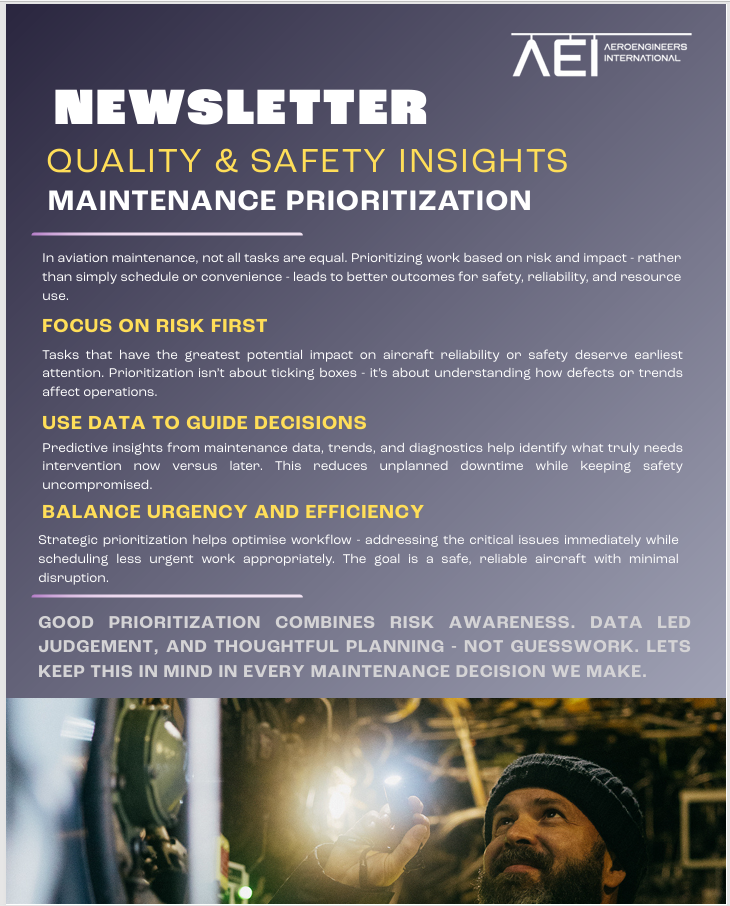
In one of our Insight newsletters, our colleague Martin Švárny wrote on the topic Maintenance Prioritization.